












Sustainability
Life Cycle Assessments
As built embodied carbon data
low carbon lead, advice & support
PAS2080 aligned carbon management
Climate change is the biggest challenge we face. Discover how we are addressing it.
To be renowned for our work with clients and communities as we construct a better world for future generations.
In order to realise that vision and continue proudly building Britain's future heritage, we want to help lead the transition to Net Zero and develop solutions that address this challenge.

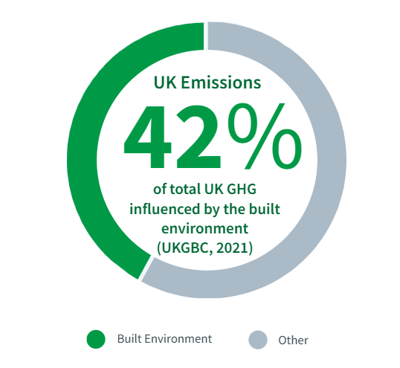
The buildings and infrastructure that form our built environment are a significant source of greenhouse gas emissions (GHG). Reducing these emissions and transitioning to Net Zero poses a significant challenge.
It won’t be easy. We know it can’t be achieved alone.
It’s why we developed our carbon principles to guide us and underpin our Net Zero strategy.
"We are placemakers and an industry of problem solvers who can harness our engineering excellence to deliver a built environment fit for our future.
There’s no silver bullet to this issue, and whilst our strategy is ambitious, it reflects the scale of the climate emergency that we all face and have a responsibility to address.
We will not be able to deliver this alone. Engagement and collaboration will be key. We all have a part to play.
Our Net Zero plan has been developed to ensure we take immediate and sustained action as we reach for our 2045 goal. Our aim is to make a positive impact on communities and the environment in which we operate, as we construct a better world for future generations."
 Simon Richards, Sustainability Director, Sir Robert McAlpine
|
|
|
|
|
DON'T DELAY | COLLABORATE | BE BRAVE | REDUCE | TRANSPARENCY |
Don't let the magnitude of the challenge delay action | Work with the whole of | We will have to do things differently and embrace change | Focus on reducing our emissions and long term benefit | We will be open, honest and transparent always |
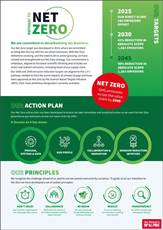
In 2020 we made a commitment to become Net Zero by 2025 for our direct emissions. Halfway towards this milestone, we recognise this isn’t enough.
Claiming Net Zero or carbon neutral status only detracts from the work that still needs to be done. Net Zero must mean more.
It’s why we have become one of the first major construction and engineering companies in the UK to have had its targets approved as Net Zero by the Science Based Targets initiative (SBTi).
 Simon Leek, Company Carbon Manager, Sir Robert McAlpine
The standard has enabled us to set ambitious and credible science-based Net Zero targets, aligned to our own carbon principles and with the Paris Agreement’s goal of keeping planetary warming to 1.5°C, thus limiting the worst impacts of climate change.
Crucially, our targets include all material sources of direct and indirect emissions, including those of our supply chain, and prioritise deep emission reductions of 90% by 2045. Before permanently neutralising residual emissions in line with SBTi criteria and reaching Net Zero.
We know reaching Net Zero will not be easy, but it’s increasingly clear that we no longer have the luxury of failure.

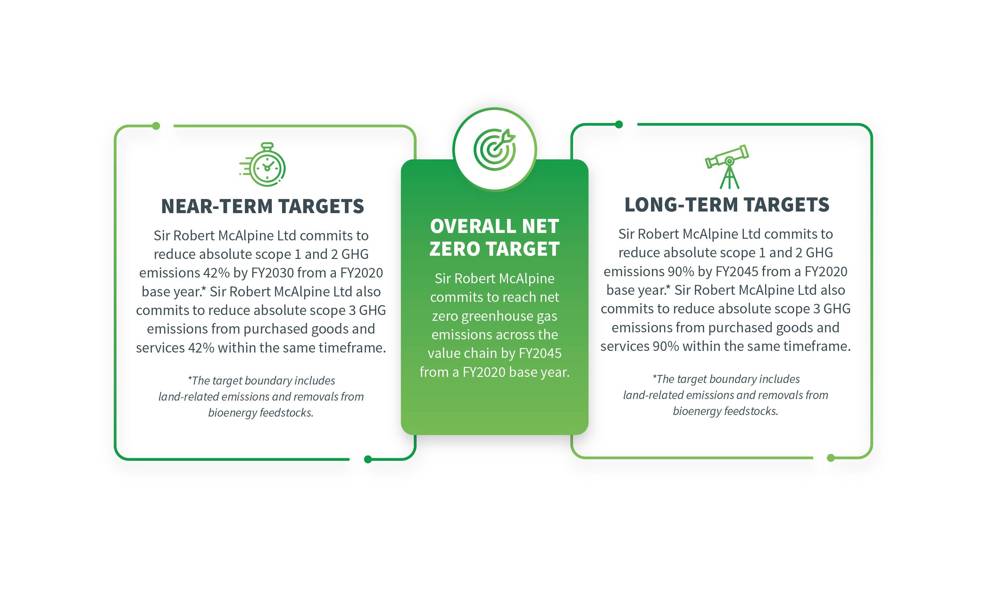
Net Zerp: GHG Emissions across the value chain by 2045
2030 Near term target: Reduce absolute scope 1, 2 & 3 GHG emissions from purchased goods and services by 42%
2045 Long term target: Reduce absolute scope 1, 2 & 3 GHG emissions from purchased goods and services by 90%
Neutralise residual value chain emissions: Achieve long term and neutralise residual emissions of full value chain through the permanent removal and storage of carbon from the atmosphere via the purchase of high quality, certified removals.
|
| |
|
| |
|
| |
|
| |
|
| |
|
| |
|
| |
|
|
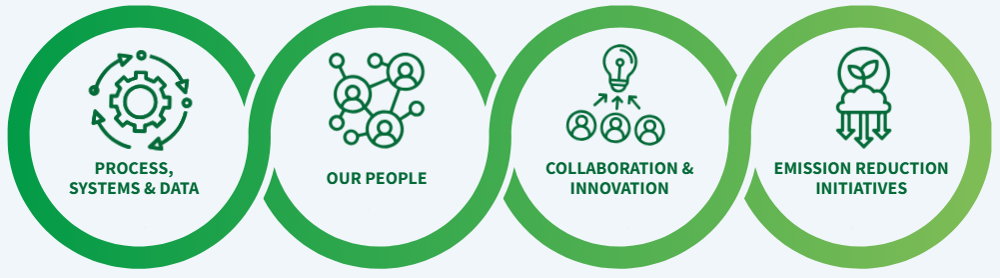
Our Net Zero action plan has been developed to ensure we take immediate and sustained action as we drive for
Net Zero greenhouse gas emissions across our value chain by 2045
| ||||||
|
|
|
| |||
|
|
|
| |||
|
|
|
| |||
|
|
|
| |||
|
|
| ||||
|
|
| ||||
|
|
| ||||
|
|
| ||||
|
| |||||
|
| |||||
With transparency a key principle, our footprint has been calculated in line with the GHG protocol corporate value chain standard and independently verified and validated in accordance with ISO14064-1: 2018.
Our approach and methodology has also been reviewed by the SBTi and checked against its Net Zero standard, ensuring a robust, science-based approach has been adopted and that all material sources of emissions, including those of our supply chain, have been calculated as part of our footprint.
Given the significant impact our Scope 3 emissions have, bringing them within scope highlights this impact, and provides the impetus and opportunity to work collaboratively with our value chain to target reductions.

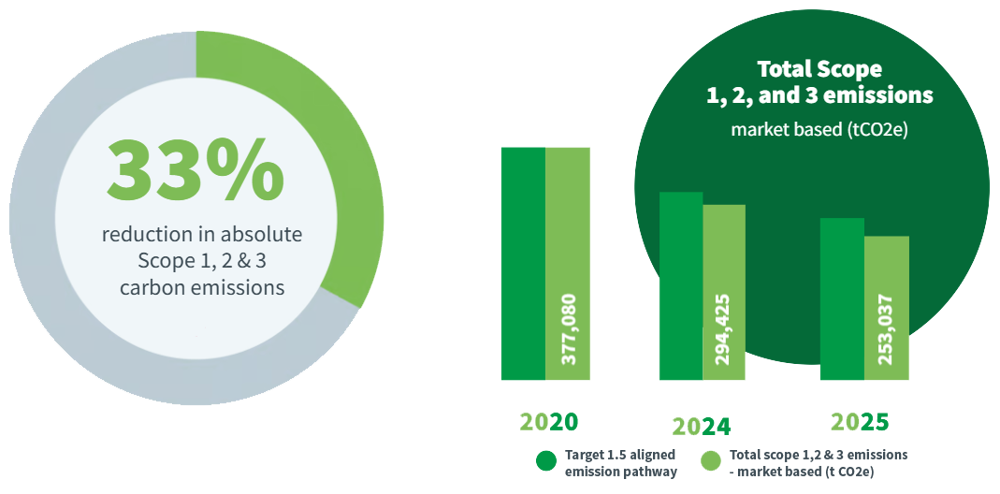
We’ve made good progress to date, having reduced total Scope 1, 2 & 3 emissions by 33% since 2020.
Scroll down for a detailed breakdown of our Scope 1,2 & 3 emissions performance.
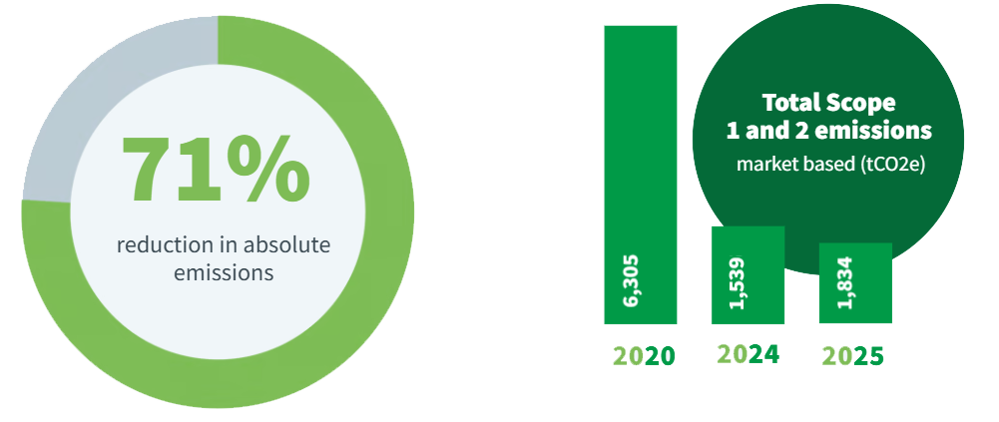
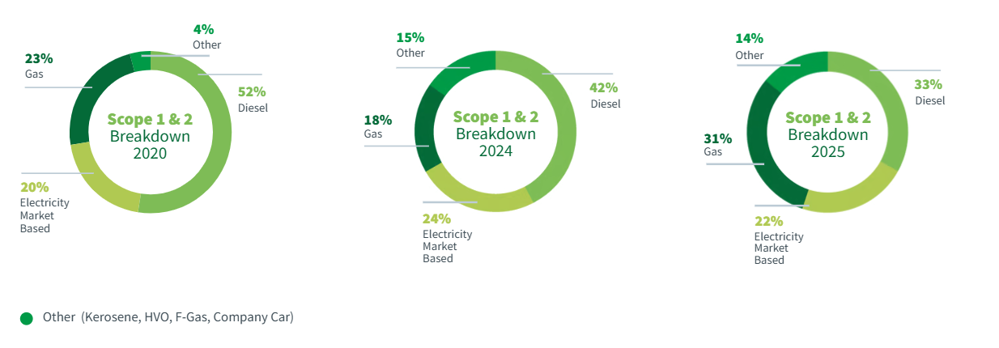
We've reduced our Scope 1 & 2 emissions by 71% since 2020.
This performance is driven by electrification of energy sources, the continued roll-out of renewable electricity tariffs and transition fuel, Hydrogenated Vegetable Oil (HVO), as a replacement for more carbon-intensive diesel.
Full breakdown
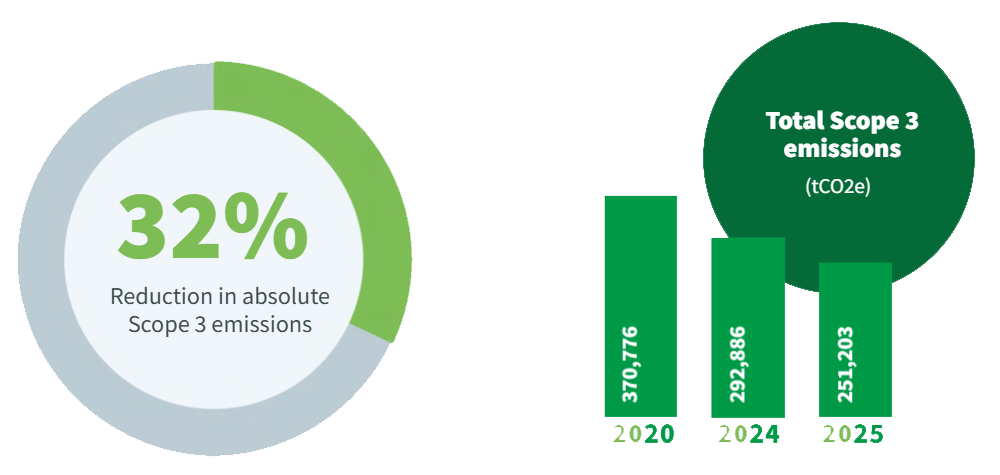
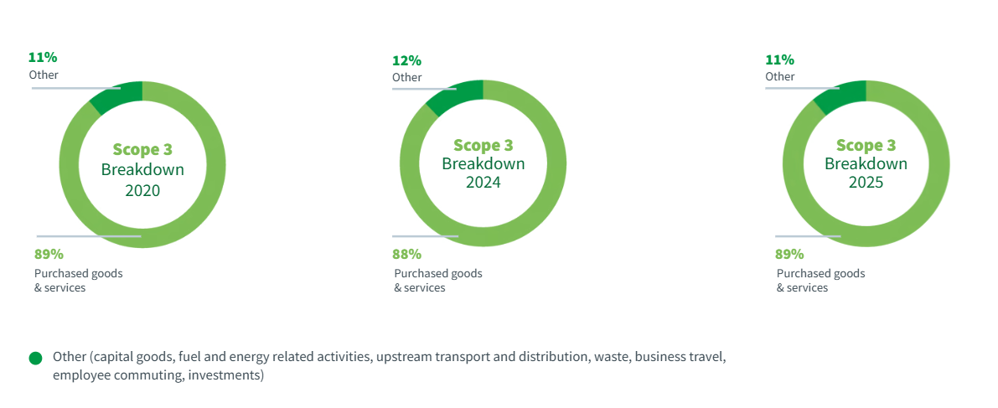
We’ve reduced our scope 3 emissions by 32%. We continue to improve the accuracy of our data by transitioning from a spend based approach to material specific quantities
Full breakdown
Our integrated centres for excellence deliver low carbon solutions for our clients and projects at all stages of the project lifecycle:
Life Cycle Assessments
As built embodied carbon data
low carbon lead, advice & support
PAS2080 aligned carbon management
Low carbon design and systems
Whole Life Carbon solutions
Key supply chain relationships
Whole Life Carbon solutions
Optimized environmental strategies
Soft landings – operated as designed
Efficient
temporary works
Low carbon structures
Concrete innovation
Passivhaus
Whole market solutions
Strategic framework suppliers
Market testing
Full supply chain traceability
Low carbon site establishment
Low carbon plant & equipment
 We’ve become one of the first Tier 1 contractors to meet the PAS 2080:2023 standard for both our buildings and infrastructure divisions. This certification demonstrates that we have the systems, processes and capability to manage net-zero aligned performance on our projects throughout their lifecycles.
Our carbon management system has several benefits for projects, including:
Ensuring carbon implications are considered alongside cost, programme and quality when project decisions are made – drawing on robust data and relevant experience
Creating a framework for collaboration within project teams and the wider value chain – eliciting effective ideas at the right time and making sure everyone understands their responsibilities
Giving clients confidence in the delivery of net-zero aligned carbon targets and the associated sustainability accreditations desired
Sir Robert McAlpine have delivered an exceptional carbon management system which has secured the verification of PAS 2080:2023. This is a real achievement, supporting carbon reduction across their built environment portfolio of projects.
Matthew Pygott Lead Verifier, Hydrock Ltd
An essential part of embodied carbon assessments and optioneering is having access to up-to-date and precise material quantity information.
SRM has been partnered with digital solutions provider Dalux since 2018, and since its release in Q3 2023, SRM has been rolling out the Dalux ‘Quantities’ function on all projects. This tool enables streamlined 3D model-based quantification and estimation of construction materials.
Project-based staff can now easily extract quantity information from live designs to inform embodied carbon analysis, target setting, and the embedment of carbon in our decision-making process. The tool is helping us deliver lower carbon outcomes and with greater certainty of the results.
With alternative fuels such as Hydrotreated Vegetable Oil (HVO), reducing CO2 emissions by up to 90%, we're using them as a key transition fuel on our decarbonisation journey.
We've used more than 1.9 million litres of HVO fuel on our projects to date, saving over 5,000 tCO2e. We acknowledge the challenges and risks associated with the use of HVO, and have worked hard to ensure the provenance of our supply meets our ethical and responsible sourcing requirements.
Our plant department in Kettering has been trialling the use of a cutting-edge Hydrogen Power Unit (HPU) to deliver Net Zero power.
The HPU from GeoPura uses green hydrogen to generate zero-emission electricity, offering a sustainable plug and play alternative to diesel generators. With only water and heat as by-products. The week-long trial generated nearly 6,000 kWh, saving 8 tCO2e, 56kg NOx and 2 kg Particulate Matter, compared to a diesel equivalent. Noise levels were also reduced, due to quieter operation of the HPU.
Overall, the trial proved hydrogen technology as a safe and viable alternative for projects that lack access to a permanent electricity supply but are looking to achieve zero-emission site power.
1 Broadgate stands out as the first large-scale project to implement a digital-led material passport process.
Material passports are digital documents detailing a building’s components, characteristics, and materials. They provide vital information that helps track the materials used during construction, such as specific concrete mixes, façade components, and steelwork origins. This data supports the reuse and repurposing of materials, promoting a circular economy and reducing waste and carbon emissions.
The project received an innovation credit under BREEAM for this initiative – utilised as part of the project strategy for BREEAM Outstanding. The initiative also won the ‘Delivering Sustainability with Digital Innovation’ accolade at the 2024 Digital Construction Awards.
Using less material as an industry is fundamental to reducing emissions.
Our Three Chamberlain Square project in central Birmingham has demonstrated this by utilising a lean post-tensioned concrete structural frame and an innovative off-site prefabrication approach to the drylining works. Reducing material use, waste and emissions.
By reducing material use and reducing waste, the project is currently on track to achieve an embodied carbon result of just 479 kgCO2e/m2 (A1-A5), an exceptionally low figure for an entirely new building, along with BREEAM Outstanding and NABERS 5* accreditations.
The Forge is the world's first major commercial building to be designed and built using the platform approach to Design for Manufacture and Assembly (P-DfMA).
The approach maximises the efficiency of materials and minimises waste, with an estimated 18% less steel and 13% less concrete compared to a traditional solution. The development won the Innovation award at the 2024 BCO (British Council for Offices) Awards.
The Forge is also the first commercial building to be both constructed and operated in line with the UKGBC’s ‘Net Zero Carbon’ buildings framework. The building delivered an estimated 38% embodied carbon (A1-A5) saving compared to the project’s Stage 3 ‘BAU’ baseline. The building is also fully electric, achieving an 'A' EPC rating and is expected to achieve a 5-star NABERS UK rating once fully operational.
At our Broadgate framework with British Land, we have minimised our demand for new steelwork through engineering excellence.
At our 100 Liverpool Street project, we retained approximately one third of the pre-existing structural steel frame. At 1 Broadgate, we sensitively dissembled 140 tonnes of structural steelwork from the existing asset to be re-used in another London development. Lastly, at 2 Finsbury Avenue, we identified 98 structural steel beams that could be disassembled from the existing asset and reused within the newly constructed development – saving approximately 43 tonnes of CO2e (A1-A3).
We have been utilising basalt reinforcement in lieu of steel within our projects temporary works This includes basalt reinforced temporary guide walls at 2 Finsbury Avenue and temporary foundation pads at our Align JV at HS2.
Basalt comparatively reduces carbon emissions by ~60% (A1-A3) compared to steel. It is also significantly lighter and requires no hot works, improving health and safety on our sites.
At a project in central London, we have been utilising a 100% Portland cement free mortar for internal masonry blockwork walls.
At a project in central London, we have been utilising a 100% Portland cement free mortar for internal masonry blockwork walls. The ‘Cemfree’ mortar provides embodied carbon savings of around ~70% (A1-A3) compared to industry leading Portland cement-based mortars. The mortar is also considered easier to clean off and remove, therefore a greater potential for blockwork to be reused when the walls are eventually demolished.
One of the barriers to lower carbon glazing products is the lack of high-quality post-consumer cullet returning to production facilities.
At our National Gallery 200 Welcome Project, we successfully coordinated the careful removal of pre-existing architectural grade glass and returned it a UK glass manufacturer for recycling into new glazing products, helping reduce emissions in the factory.
One of the barriers to lower carbon glazing products is the lack of high-quality post-consumer cullet returning to production facilities.
At our National Gallery 200 Welcome Project, we successfully coordinated the careful removal of pre-existing architectural grade glass and returned it a UK glass manufacturer for recycling into new glazing products, helping reduce emissions in the factory.
The Museum of London team collaborated with the supply chain to reduce the embodied carbon of concrete used on site, whilst also reducing reliance on GGBS in accordance with the latest low carbon industry guidance.
A newly BS 8500:2023 compliant ternary blend cement (CVI-SL) was introduced for self-compacting concrete and visual concrete mixes. This reduced the Portland cement content, whilst also reducing reliance on GGBS as a cement replacement, by incorporating limestone filler as a ternary blend. The change helped reduce embodied carbon on the project whilst improving the availability of GGBS in the market.
At HS2’s Align consortium – a joint venture between Sir Robert McAlpine, Bouygues Travaux Publics, and VolkerFitzpatrick – we trialled the use of an ultra-low-carbon concrete with manufacturer Tarmac for the floor slab and parts of the walls for a pre-cast factory.
The new low carbon concrete has a carbon footprint following industry BSI PAS2050 calculation rules that gives a 62% reduction in CO2e per cubic metre of concrete, compared to a standard CEMI concrete, meeting the same specification in the same raw materials. The mixes trialled used up to 90% supplementary cementitious material (SCM) with an alkali activated cementitious material conforming to BS EN197.
We recognise the importance of the circular economy in mitigating climate change. All our projects have access to the Excess Materials Exchange (EME) platform, this digital matching platform connects companies in the construction sector, enabling them to identify, exchange, and repurpose excess materials transforming potential waste into valuable resources.
The materials we exchange through the platform are assigned a digital resources passport, providing a comprehensive material identity which can be tracked and traced through the supply chain – ensuring accountability and transparency. The platform helps our projects increase the number of reclaimed materials used in our works and maximise the reuse of waste generated on our sites.
The typical nature of power consumption on construction sites means peaks and troughs are common. However, this also means generators are often oversized due to the misconception of incorporating greater power to meet start-up demand. By understanding the load profile and any patterns or timings, we can optimise the use of BESS, and integrate the best generator and BESS combination to reduce fuel costs and emissions.
We partnered with specialist Aggreko to analyse five live tower cranes for emissions and fuel savings utilising smaller generators, BESS, and more sustainable fuels. Our projects achieved an 85% reduction in emissions across the five tower cranes with Aggreko’s BESS after rightsizing generators. That is equivalent to more than 234 tonnes of CO2 and 87,300 litres of fuel saved.
Our PAS 2080 accredited carbon management system rewards our sites for utilising electric machinery instead of plant with internal combustion engines. This can reduce carbon emissions whilst also creating a healthier work environment for site operatives and reducing nuisance to our local communities.
An example being our Barkers of Kensington site in central London, through consultation our supply chain used a plethora of electric machinery such as electric telehandlers, electric mini-excavators, electric wheel dumpers, electric mini-dumpers and a number of electric robotic breakers.
The engineers at MDG found that the proposed solution could be significantly refined saving cost, time and materials, plus the associated embodied carbon reduced through the saved materials. The MDG optimised design reduced steel usage by over 18 tonnes and eliminated 150 metres of associated welding – this intervention saved a comparative 41tCO2e (A5).
View our current Carbon Reduction Plan
View our pathway to Net Zero
Scope 1 emissions: direct emissions from sources owned or directly controlled by the organisation e.g., use of fuel in SRM plant
Scope 2 emissions: indirect emissions from purchased energy e.g., electricity we use
Scope 3 emissions: indirect emissions that are a consequence of our activities but arise from sources that are not owned or directly controlled by us e.g. embodied carbon of materials.
Science based pathway / target: trajectory/target to achieve global Net Zero emissions based on scientific evidence.
1.5°c aligned pathway: emissions are reduced in line with a 1.5°c warming scenario/budget. The scientific consensus is that we must limit global warming to 1.5°c or below to limit the worst impacts of climate change.
Net Zero: Permanently neutralising any residual emissions at the net-zero target year and any emissions released into the atmosphere thereafter. Residual emissions can not exceed 10% of baseline year emissions.
Residual emissions: emissions that remain after taking all possible actions to implement emissions reductions.
Carbon removal: permanent withdrawal and storage of carbon from the atmosphere as a result of deliberate human activities.
Carbon offset: emissions reduction or removal resulting from an action outside the organisations boundary used to counterbalance the organisations residual emissions.
Greenhouse gases: Greenhouse gases (GHGs) such as Carbon dioxide (CO2), methane (CH4) and nitrous oxide (N2O) are gases in the earth's atmosphere that trap heat.
Life cycle assessment: A procedure to quantify carbon emissions (embodied and operational) and other environmental impacts (such as acidification and eutrophication) through the life stages of a building. The EN 15978 standard is typically used to define the different life cycle stages.
Embodied carbon: The carbon emissions associated with the extraction and processing of materials, the energy and water consumption used by the factory in producing the products, transporting materials to site, and constructing the building. As well as the carbon emissions associated with the ‘in-use’ stage (maintenance, replacement, and emissions associated with refrigerant leakage) and ‘end of life’ stage (demolition, disassembly, and disposal) of the building over its lifecycle.