
Exercise Resilient Way kickstarts our future leaders’ journey
08 Oct 2026The company's investment in young talent has led to the launch of a new Leaders of the Future programme
The centre is part of the government's New Hospital Programme and is situated on a 365-acre rural estate
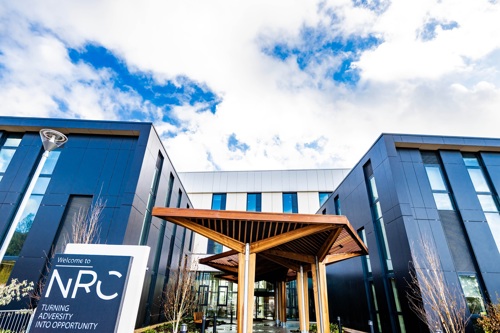 Built by Integrated Health Projects (IHP), the joint venture between VINCI Building and Sir Robert McAlpine, the NRC is a 70-bed, state-of-the-art specialist rehabilitation centre for NHS patients who have experienced a life-changing illness or injury and is run and staffed by Nottingham University Hospitals NHS Trust (NUH).
NUH has developed a transformative clinical model to be able to deliver more intensive treatments and rehabilitation earlier in a patient’s journey, and has created a bespoke workforce and relevant training to support this.
The brand-new facility is co-located with the Defence Medical Rehabilitation Centre (DMRC) on the Stanford Hall Rehabilitation Estate (SHRE) near Loughborough.
The concept of establishing Defence and National Rehabilitation centres on a single site was that of the late 6th Duke of Westminster back in 2009 and he purchased the SHRE for the purpose. At the same time the Black Stork Charity was specifically created to achieve the overall concept – not least by means of a successful funding campaign to raise the necessary £300m to create the Defence establishment and enable the National one.
Capital funding for the construction of the NRC was provided by the government’s New Hospital Programme, and the building is the NHS’s first single-site operationally carbon neutral building, featuring solar panels on the roof of the NRC and four air source heat pumps in the adjacent energy centre.
The long-term ambition for the NRC is to be the national ‘hub’ in a future ‘hub and spoke’ model, or a single model multi-site service, with regional rehabilitation units (‘spokes’) established across the country to widen impact and benefit as many patients as possible.
NHS patients at the NRC will benefit from:
Earlier access to rehabilitation to enable better outcomes
Bespoke intensive rehabilitation programmes for each patient, supported by a dedicated and highly-skilled workforce, to enable them to reach their full potential during their recovery
Unlimited access to the 365-acre countryside Stanford Hall Estate including a 5km trim trail, a hand-cycle track, a fishing lake, and a pitch and putt golf course
The most comprehensive robotics suite in the NHS, featuring cutting-edge technology from across Europe, including robots and devices which can be used when helping patients to walk again, relearn how to use their hands, and build function in specific parts of their body
The first 360-degree partial body weight support system Zero G (similar to a hoist) in the UK, located in the main NRC gym and enabling patients to learn to walk and move in a more realistic way
A digitally-advanced facility with real-time location technology to ensure patient and staff safety, a silent nurse call system and intelligent bedside screens to promote patient independence.
The NRC will primarily receive patients from across the East Midlands, many of them anticipated to come through the East Midland’s Major Trauma Centre – the busiest in the UK and based at NUH.
The national aspect to the NRC is that it will lead rehabilitation research and innovation, as well as providing training and education through an NRC Academy, all in collaboration with a consortium of 26 universities throughout England. Patients at the NRC will have the opportunity to take part in research during their stay, with the aim of significantly reducing the time between identifying effective new treatments and them benefitting patients. Clinical staff will also all be encouraged to take part in research and educational activity.
What happens at the NRC is anticipated to be of international significance too – the research, innovation and evolution in rehabilitation technology and treatment is anticipated to be global in its impact and future potential.
Anthony May, Chief Executive of Nottingham University Hospitals NHS Trust, said: “The difference the NRC will make to patients and families cannot be underestimated. We are standing on the precipice of something unique and groundbreaking.
"The NRC has been 15 years in the making. I should like to thank all those who have been involved for their perseverance, dedication and determination to make it a reality. I should like to pay a particular tribute to the Black Stork Charity, and both the late and present Dukes of Westminster, for their considerable and unwavering support since the vision for the Centre was first conceived.
“This is a significant moment for NUH, for rehabilitation medicine in this country, and for the many NHS patients whose lives will be changed and restored in this pioneering facility, set in a unique location.
“Moreover, the innovation, research and knowledge generated from the NRC will help develop rehabilitation nationally and internationally."
Mark Bessey, Director of Healthcare, IHP, said: “The opening of the National Rehabilitation Centre is a defining moment for healthcare infrastructure and, most importantly, for patients recovering from life-changing illness or injury.
“This pioneering facility demonstrates what can be achieved through close collaboration, technical excellence and a shared commitment to sustainability. Its smart, patient-centred design, operational carbon-neutral credentials and integrated digital technologies set a new benchmark for the delivery of healthcare environments.
“IHP is immensely proud to have worked alongside Nottingham University Hospitals NHS Trust, the New Hospital Programme and our project partners to deliver a centre that will support rehabilitation, research, innovation, education and training for many years to come.”


The company's investment in young talent has led to the launch of a new Leaders of the Future programme
Introduction of integrated information hubs impresses judges at Building Innovation Awards 2026
This independent industry certification recognises our commitment to building a workplace where everyone can thrive

